
What 10 Years on AM Northwest Taught Me: 6 Lessons Worth Sharing
Jun 02, 2026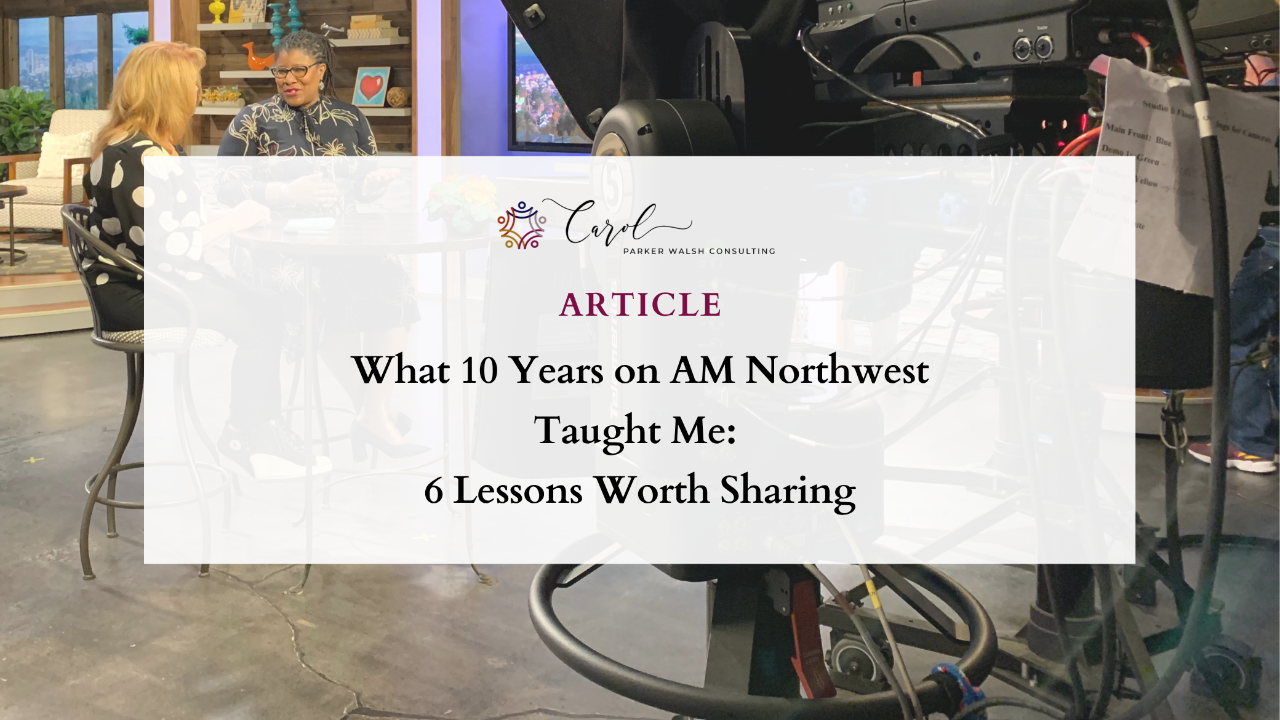
A few months ago, I decided to retire from my monthly second-Tuesday segments on AM Northwest. The timing felt right. After 29 years at the station, host Helen Raptis announced her own retirement, and her exit struck me as the natural moment to close out my own run. By then, I had recorded more than 100 segments over a decade, and ending alongside someone who had become a true friend felt fitting rather than sad.
Ten years ago, I pitched a single idea to Leslie Martin, the producer of the AM Northwest Morning Show, one of the nation's longest-running local talk shows.
One segment. One topic. I had no contract, no standing invitation, and no guarantee anyone would want me back. What I had was a point of view and the willingness to walk into a studio and share it on camera, in front of an audience I couldn't see.
That one segment changed the trajectory of how I show up in my work and in my life. Not because it was flawless, but because I said yes before I felt fully ready. And then I kept saying yes for 10 years.
As I close this chapter, I wanted to share my thoughts, reflections, and insights about what this experience taught me in an effort to encourage and inspire others who are standing at the edge of their own opportunity, wondering whether to raise their hand.
These aren't just personal lessons. Each one is a leadership principle I've watched play out in the executives I coach and the organizations I work with. So here are the six (6) lessons I learned after 10 years on AM Northwest, shared in the hope they encourage you to take your own leap and say, "Yes!"
1. It started with putting myself out there
The segment landed. The producer loved how I showed up and how the audience responded. So instead of waiting to be asked to come back, I made another ask. I pitched myself to come on regularly, and that turned into a monthly seat on the show.
None of that happens in your comfort zone. Stepping out of that zone is a choice you make before you know how it will go. You raise your hand, you offer the idea, and you accept that the answer might be no. The risk is the price of the opportunity, and, in this case, I've never once regretted paying it.
The leadership lesson: Opportunity rarely arrives as an invitation. It arrives as an opening you have to claim. Research on career advancement has long highlighted a confidence gap, particularly for women. A widely cited internal review at Hewlett-Packard found that women tended to apply for promotions only when they believed they met nearly all the listed qualifications. In contrast, men applied when they met roughly 60% of the qualifications. The leaders who advance are not always the most qualified in the room. They are the ones who are willing to raise their hands before they feel ready.
2. Visibility means you are open to critique, and that's the point
When you put yourself out there, you also make yourself reviewable and vulnerable. People watch. People judge. People form opinions about whether you're good, whether you're right, and whether you belong in that chair.
I made peace with that early on, because the same exposure that invites critique is also the one that builds reputation, relationships, and reach. You can't have one without the other. Hiding protects your ego and starves your growth. I chose growth.
The leadership lesson: Visibility is a leadership tax worth paying. In her research on workplace learning, Harvard's Amy Edmondson found that the highest-performing teams were not the ones that made the fewest mistakes, but the ones willing to surface and discuss them openly. Exposure is the precondition for feedback, and feedback is the precondition for growth. Leaders who insulate themselves from critique also insulate themselves from improvement.
3. Done beats perfect, every single time
What doesn't show up on camera (hopefully) is that some mornings, I was sick or just not feeling my best, and I still showed up. In some segments, I lost my train of thought and couldn't land the point the way I rehearsed it. Some segments were not my best work. Thanks God for an amazing interviewer like Helen Raptis, who often gave me subtle "cues" to get me back on track.
Regardless of how I was feeling, the show, as they say, had to go on, and the audience still had to get value. As a result, the lessons compounded over the ten years and over 100 episodes. I learned that showing up consistently and imperfectly will always outperform waiting for the conditions to be perfect. Perfection is a story we tell ourselves to justify staying small. Consistency is what actually builds something.
The leadership lesson: Perfectionism masquerades as a high standard, but it often serves as a form of avoidance. Decades of research by Stanford's Carol Dweck on the growth mindset show that people who treat ability as something built through effort and iteration outperform those who treat it as fixed and on display. Leaders who model "done and improving" over "perfect or not at all" create cultures where people take action, learn faster, and stop hiding their work until it is flawless.
4. My work evolved on that screen, and so did I
When I started, my focus was on image and personal branding. Over time, the conversation moved to careers, then to leadership, then to the questions executives wrestle with about how to lead people well in a world that keeps shifting.
That evolution wasn't an accident. It tracked my own growth as a practitioner and the interests that kept me curious. Staying fresh and relevant meant letting the work change as I changed, rather than repeating the same segment because it was familiar. The audience grew with me because I refused to stand still.
The leadership lesson: Relevance isn't a destination; it is a discipline of continuous reinvention. The World Economic Forum's Future of Jobs research estimates that a substantial share of workers' core skills will be disrupted within just a few years, meaning the half-life of expertise is shrinking. The leaders who stay valuable are the ones who treat learning as a permanent part of the job, not a phase that ended with their last credential. Standing still is the actual risk.
5. Lifting as I climbed
This is the part I'm most proud of.
"Lifting as we climb" was the motto of Black Women's clubs in the late 19th and early 20th century. It's a commitment that says success is incomplete if you arrive alone. It's a motto I live by. So, this platform was never meant to be mine alone. Over the years, I helped five other people get on the show, and a few of them now appear periodically in their own right.
When you have access, you share it. A seat at the table is worth more when you pull up chairs for other people. Their presence on that show is part of what this decade actually built, and it will outlast my own segments.
The leadership lesson: Sponsorship is a force multiplier, not a favor. Research on workplace advancement distinguishes mentorship, which is advice, from sponsorship, which is advocacy that spends your own capital to open doors for someone else. Studies have consistently linked sponsorship to faster advancement and stronger retention for those who receive it. The most enduring measure of a leader is not the height they reached, but the number of people who rose because they were there.
6. Connections became real relationships
The host and the producer started as professional contacts, and a decade later, we're friends. You may be thinking, "Of course, you made friends after being together for ten years." But the friendship isn't the lesson. The lesson is what produced it.
I never treated those relationships as a transaction. I didn't show up only when I needed something, network only when it was useful, or measure each interaction by what it returned. I showed up consistently, I was generous with my time and my contacts, and I let the relationships grow without keeping score. That steady, low-stakes generosity is exactly what most people skip in the rush to extract value, and it is exactly what compounds.
The opportunities from this show mattered. But the opportunities were finite, and the relationships were not. They keep generating long after the segment ended.
The leadership lesson: Relational capital is the asset most leaders underinvest in because it pays back slowly and can't be rushed. The longest-running study on adult development, Harvard's Study of Adult Development, found across decades that the quality of people's relationships was the strongest predictor of long-term wellbeing and flourishing, outpacing wealth or status. The same principle holds in a career. Transactional networking extracts once. Genuine relationship building compounds for a lifetime.
That truth holds within organizations as well. Gallup found that employees who trust their leaders are 61% more likely to stay in their jobs rather than look for another job, and that trust drives a threefold increase in engagement. Trust is the quiet infrastructure that keeps people and the work in place.
So, was it worth it?
Absolutely. Without hesitation.
My ten years on AM Northwest are an example of what happens when you put yourself out there, accept that visibility invites critique, choose done over perfect, evolve rather than repeat yourself, bring other people along for the ride, and let connections turn into lasting relationships.
I didn't wait until I was ready. I got ready by doing. That's the lesson I learned, and I'd do every imperfect minute of it again.
So if you are standing at the edge of your own opportunity, wondering whether to raise your hand, let me save you the decade of deliberation. Raise it.
----
This article was written by Dr. Carol Parker Walsh, JD, PhD, an award-winning executive coach, organizational strategist, and founder of Carol Parker Walsh Consulting Group, a leadership development firm that helps organizations cultivate People-Forward Leaders™ and high-performing teams.
A CNBC Leadership Expert and contributor to Forbes, Newsweek, and Entrepreneur, Dr. Parker Walsh has been featured on LinkedIn Learning, ABC, CBS, Fast Company, and Fortune. She's a Fellow with the Harvard Institute of Coaching, and her thought leadership has reached more than 100,000 professionals worldwide.
A nationally recognized keynote speaker, TEDx presenter, and four-time Brandon Hall Group HCM Excellence Award recipient, she empowers leaders and organizations to thrive amid disruption by building trust, alignment, and adaptive cultures that drive performance and retention.