
AI Leadership: How to Lead With AI Without Losing the Human Touch
Jan 27, 2026
I don't know about you, but doesn't it seem like things are shifting fast in the workplace? Not in a "someday" kind of way, but right now and almost every day.
While AI and its applications aren't new (we've been using analytical AI for years), generative AI and larger learning models (LLMs) are relatively new phenomena that are causing both excitement and apprehension. As generative AI continues to grow and expand, I'm watching leaders respond in one of three ways. Some are either pretending it's a passing wave they can ignore or don't see the relevance in their workplace. Others are quietly experimenting with it on the side, unsure how to integrate it openly. And then there are those going full steam ahead, purchasing tools and rolling out an implementation plan. The problem is, there aren't enough leaders thinking about how to lead with it, without properly preparing their people or ensuring they don't lose the human skills that make leadership matter in the first place.
AI won't replace what makes you human, but it can help amplify it. That includes your clarity or confusion, your confidence or chaos. Your trust in people or your credibility gaps.
That's why the real divide isn't "AI vs. humans." When leaders see AI as a threat, they'll fail to take the necessary steps to adapt and sufficiently prepare their people to adapt, ultimately leading to their falling behind. Leaders, however, who learn to partner with AI will set a standard of success within their organization for many years to come.
The New Leadership Reality: Your Job Is Shifting
In an AI-shaped workplace, leaders are being pulled into a new set of expectations. You're now expected to make faster decisions with more data and more ambiguity at the same time. You need clearer communication across more channels and more stakeholders than ever before. Your judgment is under pressure because while AI can generate options, it can't own outcomes. And you're being held to higher standards of trust in a world where people are watching closely for misuse, bias, and automation being used as a substitute for genuine care.
When the pace of work changes this dramatically, leadership gets exposed. The leaders who thrive aren't the ones with the most information; they're the ones who can become "sense-makers." The leaders who can create clarity, build trust, and help people execute consistently. Those fundamentals don't change, but how you deliver them is evolving.
You can use AI to work faster, but still lose your people in the process. The efficiency you may achieve might look good on paper, but if you're not intentional, you'll accidentally create distance where you need connection. You'll optimize for speed at the expense of trust. You'll gain productivity and lose engagement.
People-forward leaders need to do three things consistently. First, get clear about their identity and values in relation to AI. That's called Framing. Second, structure their work to protect what matters. That's Governance Structure. And finally, measuring the right things to make sure the system is actually working for their people and their business. That's ROI Evaluation or Measurement.
Define Who You Are in Relation to AI
The first question leaders must answer is not "What can AI do?" It's "Who are we as leaders, and how does AI support that or threaten it?"
I work with executives who tell me they value trust, transparency, and connection. But then they use AI to draft performance feedback, automate responses to employee concerns, and speed through 1:1s because "the AI prepped me." If speed and efficiency are your values, that behavior aligns, but trust and connection are contradictory. And your people feel it immediately.
If you're going to lead with AI, you need to get crystal clear on your identity as a leader and your values as an organization. Are you human-first? Do you believe relationships drive results? Do you see AI as a tool that amplifies your presence, or as a shortcut that replaces it?
What This Looks Like in Practice:
When you're clear about your identity and values, it changes everything about how you use AI. One CEO I work with made this decision early: "We're a people-forward company. AI helps us do the administrative work faster so we have more time for the human work that matters." That clarity became their filter for every AI tool they considered. If it created distance from people, they didn't use it. If it freed up space for a deeper connection, they leaned in.
Take communication, for example. AI can draft messages instantly, and that speed is seductive. But leadership communication isn't just about sounding good; it's about being understood. People can tell the difference between an AI-polished message and one where you've shown up with your full presence.
So yes, use AI to turn messy thoughts into structured updates, or tailor one message for different audiences, or tighten your language. That's a valuable use of the tool. But you still have to decide what must be said and what should never be said. You still have to set the tone when morale is fragile. You still have to lead the hard conversations that require courage and care.
The same goes for decision-making. AI will give you options, sometimes great ones (and sometimes confidently wrong ones). Use it to pressure-test your assumptions, generate scenarios, and identify risks you might have missed. But your leadership still owns the things AI can't touch, which are ethics, priorities, context, timing, and consequences. AI can help you think more rigorously, but it can't take responsibility for your decisions. That's still on you.
The bottom line is, if you don't define your relationship with AI, it will define you. Your team is watching how you use it, what you automate, and what you do personally. That's your leadership identity in action, so make it intentional.
Structure Your Work to Protect What Matters
Clarity about values is just the beginning. It's foundational, but you're just getting started. The next thing you need to do is structure your organization, your time, and your accountability systems to actually live those values, especially when AI makes it easy to skip the hard parts.
It's easy for leaders to adopt AI tools without changing anything else about how they work. They automate communication but don't protect time for real and honest conversations. They use AI to draft feedback, but don't create space to deliver it with care. They speed up decision-making but lose the collaboration that makes people feel heard and invested in the outcome.
Burnout isn't just about workload anymore. It's about cognitive overload: making too many decisions, experiencing too much context switching, and having too little closure. AI helps most when we use it to cut the repetitive drain on our brains, so we can stay available for real, authentic leadership. But that can only work if you deliberately structure your time and your team's work to reinforce what matters.
Here's what that structure looks like:
Protect time for unscripted human connection. Block time every week for the conversations that can't be automated, such as coaching sessions, skip-level check-ins, walking the floor, and grabbing coffee with someone who's struggling. If it's not on your calendar, it won't happen.
For example, use AI to handle meeting prep. Before a 1:1, provide context on the person's role, current projects, and what they're struggling with. Ask it for coaching questions, constructive ways to challenge, ways to affirm progress, and potential blind spots to explore. That's five minutes of prep that makes you more present, less reactive, and genuinely helpful when you sit down with that person.
Create accountability for the human stuff. If you're measuring response time and output but not relationship quality or trust levels, you're incentivizing the wrong behavior. One leader I work with added a simple question to their team's quarterly check-ins: "Where have I been present, and where have I been absent?" That single question created accountability for showing up in ways that matter.
Build collaboration into the workflow, not around it. Strategy isn't a document. It never was. Strategy is the courage to choose what you'll focus on and the discipline to align your team around it. AI can be great for scanning patterns in employee feedback, synthesizing survey responses, and drafting strategic narratives in days rather than the weeks it used to take. So use the time you save for the real work: getting people in the room to make tough choices together. Don't let efficiency replace the messy, necessary work of getting and remaining aligned.
Automate the admin, not the care. Use AI to write meeting notes once, then cascade them into three outputs: your executive summary, manager action items, and frontline plain language. Use it to create follow-up emails with clear decisions, owners, and deadlines. That efficiency will actually create clarity and reduce misunderstandings.
But don't outsource care and connection. If you're writing performance feedback, drafting a message to someone who's struggling, or responding to a sensitive situation, you need to show up fully in those words so the other person feels you care. The efficiency isn't worth the cost if people stop believing you care about them, their growth, and their success.
The structure you create either protects your humanity or erodes it. There's no neutral option.
Measure What Actually Matters
Most leaders are great at measuring results and assessing ROI, but when creating an AI workplace, make sure you're not just measuring AI results and forgetting to measure the human impact.
Yes, track efficiency gains, productivity metrics, and the number of hours AI has saved you and your team. That's fine, and necessary. But if you're not also measuring employee engagement, retention, trust levels, and the quality of relationships on your team, you're flying blind. You may be optimizing for speed, but will that matter if you're losing your best people? You can hit every efficiency target while destroying the culture that makes your organization work.
People-forward leaders are measuring success at multiple levels. They're looking at immediate results, yes. But they're also asking harder, more complex questions like: Are people more engaged or more burned out? Is trust going up or down? Are we retaining talent, or are we watching people leave? Do employees feel more supported or more replaceable?
One executive team I worked with started tracking what they called "connection metrics" alongside their performance metrics. They measured:
- How often managers were having meaningful 1:1s (not just checking boxes)
- Employee feedback on whether they felt heard and valued
- Retention rates, especially among high performers
- Pulse survey data on trust and psychological safety
- Whether people felt AI was helping them or adding to their stress
What they found surprised them. In some areas, AI was making things better, like freeing up time, reducing admin burden, and helping people focus on work that mattered. But in other places, it was creating distance. Managers were relying too heavily on AI-generated feedback and not enough on personable conversation. Employees felt like they were being "managed by an algorithm" instead of being led by humans.
That data was extremely critical in helping them change how they used AI. They didn't abandon it; they just recalibrated. They kept using AI for the prep work, but reinforced expectations that human leadership still had to show up. And six months later, when they measured employee engagement with AI, overall, their engagement scores went up, and their productivity stayed strong.
That's the real ROI you need to track. Not just dollars saved or hours gained, but trust built, relationships strengthened, and people retained.
If the answers to those questions are no, it doesn't matter how efficient the AI made you. You're losing what matters most.
The Bottom Line
AI won't replace leaders. But it will replace:
- Slow, vague communication
- Reactive decision-making
- Leaders who confuse activity with impact
- Leaders who refuse to evolve
- Leaders who forget that people, not productivity, are the point
In the AI era, your edge is not knowing more. It's leading better. Clearer. Calmer. More consistent. More human. More accountable.
The future belongs to leaders who can partner with AI and still create trust. Leaders who know their identity and values, who structure their work to protect what matters, and who measure success in ways that include the people they're leading, not just the results they're chasing.
That's the work. That's what matters. And that's what will set you apart as an irreplaceable leader.
Your Next Steps
If you lead a transit agency and you've been sitting with the question of how to actually navigate AI without losing your workforce in the process, I built something specific for you.
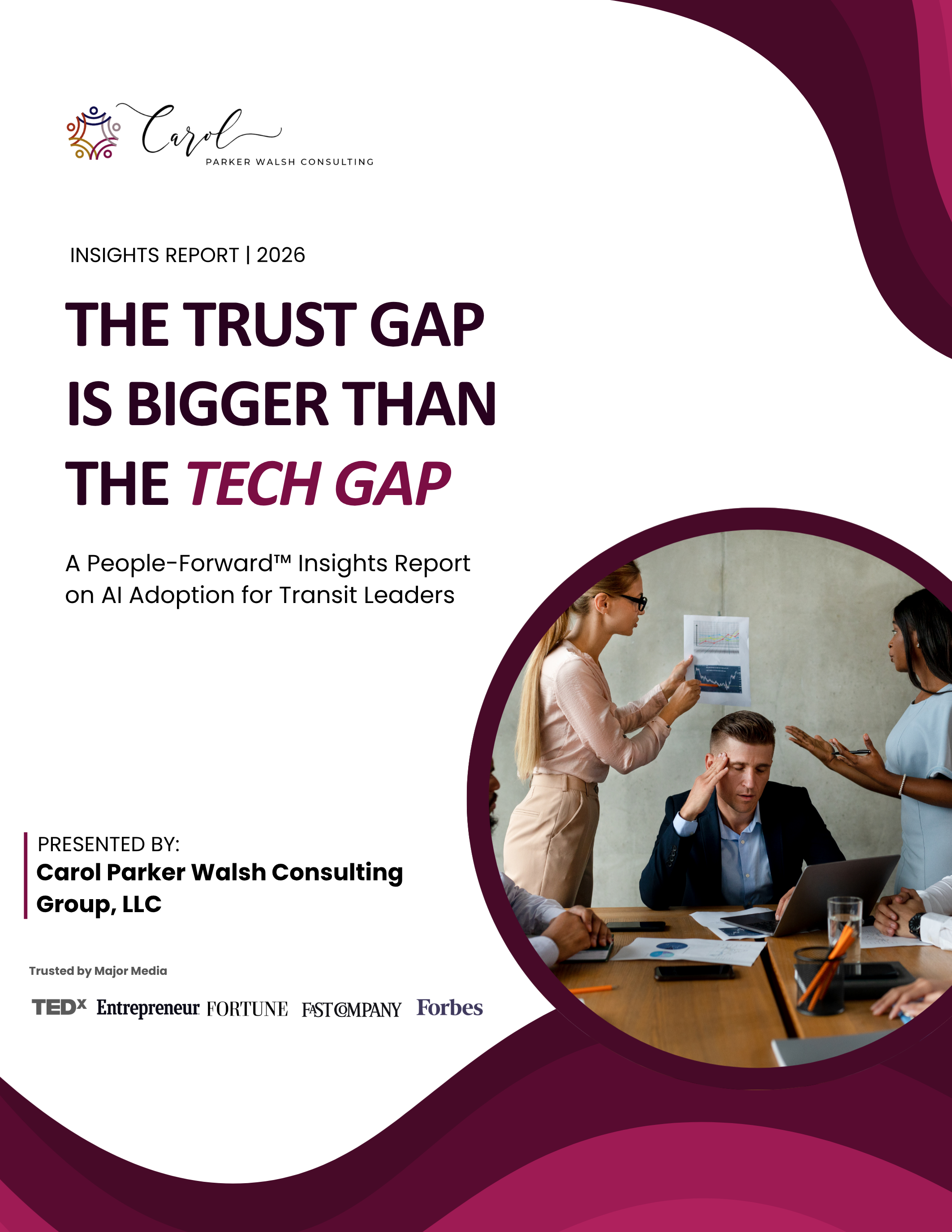
The Trust Gap Is Bigger Than the Tech Gap is a 30-page insights report I wrote for transit executives. Inside, you'll find:
- Why transit's operating context makes most AI playbooks the wrong fit
- The four distinct layers of AI showing up in your workforce, each requiring a different leadership response
- The leadership architecture that determines whether your AI deployments land or stall
- A 90-day game plan organized around the three responsibilities of leadership: framing, structuring, and evaluating
- A 10-question self-check so you can gauge where your agency actually stands
It's the diagnostic and the architecture that every transit CEO, COO, and CHRO needs to read before they entertain another vendor pitch.
Get the Insights Report HERE
---
This article was written by Dr. Carol Parker Walsh, JD, PhD, an award-winning executive coach, organizational strategist, and founder of Carol Parker Walsh Consulting Group, a leadership development firm that helps organizations cultivate People-Forward Leaders™ and high-performing teams.
A CNBC Leadership Expert and contributor to Forbes, Newsweek, and Entrepreneur, Dr. Parker Walsh has been featured on LinkedIn Learning, ABC, CBS, Fast Company, and Fortune. She's a Fellow with the Harvard Institute of Coaching, and her thought leadership has reached more than 100,000 professionals worldwide.
A nationally recognized keynote speaker, TEDx presenter, and four-time Brandon Hall Group HCM Excellence Award recipient, she empowers leaders and organizations to thrive amid disruption by building trust, alignment, and adaptive cultures that drive performance and retention.
Unlock the #1 Issue Plaguing Today's Leaders
Get Time Savvy for Busy Leaders Today!
Time is the scarcest resource leaders have, and how it's allocated matters significantly. As a leader, mastering time management is crucial - it's essential for being present for your team, prioritizing work effectively, and driving your organization forward.
Get the Latest Leadership Insights
Sign up with your email address to receive news & updates about coaching, leadership development, and strategic advising!
We hate SPAM. We will never sell your information, for any reason.
